


Meet the Funder Webinar
You can download our Meet the Funder Webinar recording below. It covers questions and information about the Crisis and Resilience Fund.
Please note: The Meet the Funder recording below was filmed during Round 1. While it provides useful context on the fund’s overall focus, specific details regarding grant amounts, timescales, and eligible costs for Round 2 differ. Please refer to the guidance on this page for Round 2 specifics.
Crisis and Resilience Fund | Meet the Funder Webinar
Question and Answer (Q&A) document in response to questions raised during the Webinar
Background and context
The Crisis and Resilience Fund (CRF) is a new 3-year programme, funded by the UK Government, which started on 1 April 2026. CRF replaces the Household Support Fund (HSF) and has a clear shift in emphasis. While crisis support remains important, the focus is now on building resilience, supporting people to be better equipped to manage financial pressures, reduce the likelihood of repeat crises, and improve longer-term outcomes. Successful CRF activity across Leeds should change the landscape over the next three years, helping people become more financially resilient and less dependent on free emergency food aid.
The CRF in Leeds is led by a partnership of the following organisations:
- Voluntary Action Leeds (VAL)
- Forum Central
- Leeds Older People’s Forum (LOPF)
- Leeds Community Anchor Network (LCAN)
- Leeds Food Aid Network (FAN)
About the fund
This is a three-year programme, and a shared journey with the sector. CRF is focused on achieving the following Resilience outcomes:
- Reduced experiences of material deprivation
- Reduced need for emergency food parcels
- Increased access to appropriate and quality advice services
- Increased savings
- Reduction in priority debt
- Maximisation of individuals’ incomes
- Decreased need for crisis/housing payments
We understand that third sector organisations may need to progress and develop their ‘resilience offer’ during the funded period, and that your organisation may not have everything in place at the start of the grant. We are interested not only in what you are delivering now, but how you see your work developing as part of building resilience within your community. Successful and unsuccessful applicants will be offered ongoing support from one of the CRF partners.
We have produced a visual guide to the types of activity that can support resilience, and this is available to download in the ‘Further Information’ section below. Please note that these are examples and not exhaustive.
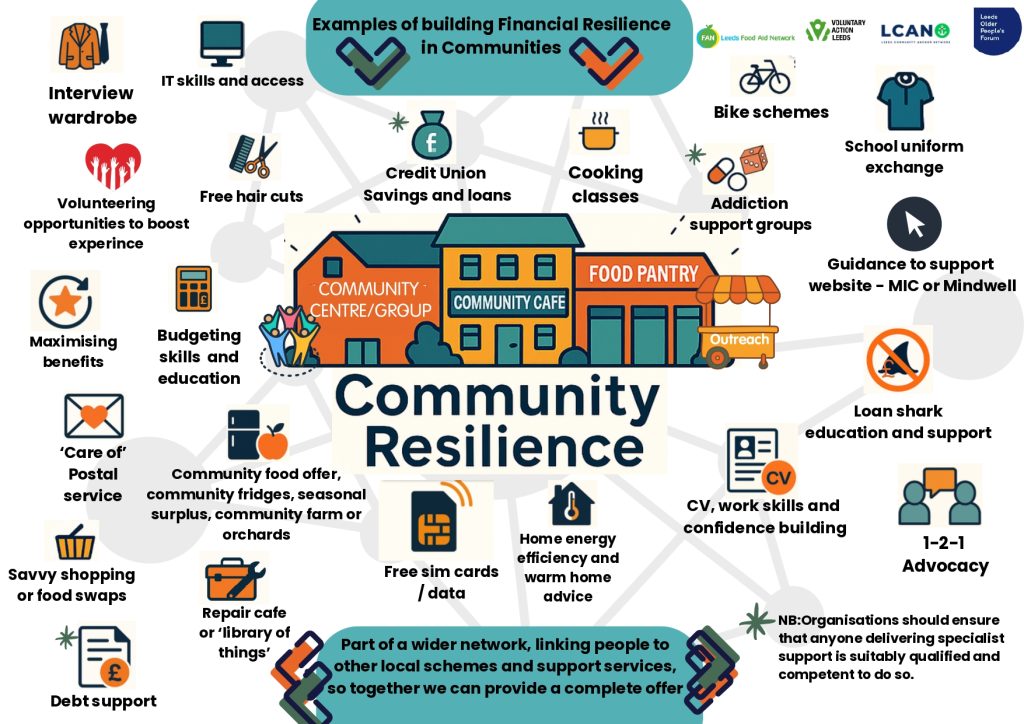
Work funded by CRF helps to reduce individuals’ dependence on free emergency support (especially food) and increase independence (resilience). We know food is often an effective way for organisations to engage people, and this will continue to be supported where resilience-building is part of the approach. Funding will prioritise work that goes beyond meeting immediate need by offering more holistic, wrap-around support, including links to advice, financial assistance, skills, and wider community opportunities.
There will also be a strong emphasis on partnership working. We actively encourage collaborative approaches, where organisations come together to combine their strengths and offer joined-up support. For example, a community anchor or similar organisation may choose to submit a partnership bid on behalf of a group of local organisations, demonstrating how working together can strengthen community resilience.
CRF work should link to the following principles:
- person-centred
- needs-based
- holistic
- a ‘no wrong door’ approach to supporting individuals
- trauma informed
Details of the CRF Foundation grant round 2
Grant applications open: Tuesday, 15 September 2026
Grant applications close: Midnight, 4 October 2026
Grant decisions by panel: We aim to notify you of the panel’s decision by 15 October 2026
Amount: Unincorporated organisations can apply for a maximum of £3,000. There is no maximum amount you can apply for if your organisation is incorporated/registered.
As with Round 1 funding, there is no cap on the amount you can apply for. As a rough guide, the average grant awarded in Round 1 was approximately £17,598, while the median award was £10,000. Please note that the amount available in Round 2 is significantly less than in Round 1.
Duration of grant:
- Round 2 grants are available for only 5 months for work to be done between November 2026 and March 2027.
You’ll be expected to collect monitoring information for the duration of your grant and submit this on a spreadsheet. We expect most organisations to select a minimum of one and a maximum of two resilience outcomes. If you’re applying for a smaller amount of money, we only expect you to select one outcome. Please choose carefully. This is because grantees will report back on these outcomes in their monitoring, as they form a key part of expectations set by Central Government. All grantees will need to complete an online end-of-grant monitoring report, and a small number of grantees will also be asked to provide more detailed information in a case study, which we will share with Leeds City Council. You’ll find the monitoring spreadsheet in the ‘Further Information’ section below to help you develop your grant application.
What is the Grants Panel looking for?
Applications do not need to be lengthy. We are looking for:
- Clear and concise answers that demonstrate how resilience-building activity sits alongside any crisis intervention work
- A clear explanation of how your activities contribute to one or two CRF resilience outcomes
- Information on the resilience work done since April 2026 for organisations applying for a 12-month grant
- Evidence that your organisation is well connected to and trusted by the community it serves
- Clear and realistic activities which are deliverable within the funding period
- An explanation of how your organisation hopes to develop its resilience offer over the lifetime of the fund
- Evidence of joined-up working. This does not need to be a formal partnership bid, but applicants should demonstrate how they connect people to other organisations, services, or support within their area or community
- For partnership bids, applications will also be assessed on their approach to partnership working, including how organisations will collaborate, refer, and contribute to building community resilience
- A clear top-line budget showing how funding will be spent and how it will provide direct benefit to communities
- Realistic estimates of how many people will benefit, and how these figures have been calculated
- Activities that are person-centred, holistic and build independence, rather than providing crisis support alone
Remember: You do not need to have everything in place from day one. We recognise that organisations are on a journey, and we are interested in both what you are delivering now and how you plan to strengthen resilience within your community over time.
Who can apply?
- If you received a CRF grant in Round 1, you are unable to apply for a grant in Round 2 due to the limited funds available
- No brand new staff positions can be funded in Round 2 due to the short grant period and the fact that CRF funding has not been confirmed for future years. However, existing staff can be reallocated to CRF work, or hours increased, within your application budget.
- Small unincorporated and unregistered organisations (i.e. not a registered charity, CIC or social Enterprise) can apply and will be eligible for grants up to £3,000
- As with Round 1 funding, there is no cap on the amount you can apply for. As a rough guide, the average grant awarded in Round 1 was approximately £17,598, while the median award was £10,000. Please note the amount available in Round 2 is significantly less than the amount available in Round 1. Applicants should apply only for the level of funding necessary to deliver their proposed activity, taking into account the finite nature of the fund and the need to distribute resources fairly across Leeds.
- Organisations supporting people with No Recourse to Public Funds (NRPF) can apply. While CRF funding should not normally be used to support people who are ineligible for public funds, they are not automatically excluded from the fund. In limited circumstances, support may be possible where the Council or relevant Authority can rely on other legal powers to meet wider duties, such as meeting eligible care needs, addressing child welfare concerns, improving public health, or preventing a breach of human rights. Where support is based on these alternative legal powers, rather than the Localism Act 2011, support may be provided to people with NRPF. Any decision to use CRF funding in these circumstances must be considered on a case-by-case basis, taking account of the relevant legal powers, duties, NRPF legislation and CRF guidance. If required, additional information is in the ‘Further Information’ section below
- Schools are not eligible for this fund unless part of a partnership bid. You must show how you are offering more than just crisis intervention to be funded; this can be as part of a wider partnership, which we encourage
How to apply
We have created a range of ways that groups and organisations can apply for a CRF grant:
Online: To complete an online application via Jotform, please click this link to take you to the online CRF grant application form. This is our preferred way to receive applications.
Email: Download the application form to your computer, type your answers, save it and email it to grants@forumcentral.org.uk
Post: Call Forum Central on 0113 244 1697 to request a printed copy of the application form and guidance notes. Alternatively, download the application form, print it, handwrite your answers and post to:
CRF Grants team, Forum Central, Suite E1 Joseph’s Well, Hanover Walk, Leeds LS3 1AB
Voice recorder: Read the questions on the application form and speak your answers into a voice recorder app on your smartphone, then email this audio file to grants@forumcentral.org.uk
If you are awarded funding, we will send you a link to an online CRF grant agreement form which must be signed and returned to us for us to release funds.
Further Information
- Grant information sheet (PDF)
- A visual guide to the types of activity that can support resilience (JPG)
- Word version of the CRF grant application form (Word)
- Link to the online version of the CRF application form (Jotform | No login required)
- CRF Partnership Guidance – Frequently Asked Questions (PDF)
- CRF Summary of Central Government Guidance for Local Authorities: Information for Third Sector colleagues to help to put this fund into a national context (PDF)
- Additional information about supporting people with No Recourse to Public Funds (PDF)
To support third sector organisations to provide relevant and timely advice to individuals, we have asked Chapeltown Citizens’ Advice Bureau to develop ‘Advice First Aid’ training. This will be freely available, and all CRF-funded organisations are expected to send at least one representative to this training before March 2027 (likely to be two half-day sessions).
If you have any questions about the grant application process, please email grants@forumcentral.org.uk or call 0113 244 1697.